
The Tabletop Chronicles: Part 2
The one about Critical Role.

I consider myself a fan of Critical Role.

I have watched the whole of Vox Machina (the actual play, not the animated TV show), and I am halfway through the Mighty Nein actual play, although I will admit I am not as interested in it as I was in their first campaign.
Critical Role is a great example of Dungeons and Dragons taken to the peak in the roleplaying aspect. The world, the story, the characters… everything comes together in every session that the group plays to provide viewers with the modern equivalent of a radionovela, where each “episode” advances the story while showing dramatic encounters between the different player characters as well as the non-player characters narrated and performed by the Dungeon Master, Matt Mercer.
However, as much as I would say that I enjoy Critical Role, I must say… I don’t think they have helped make the hobby better. Allow me to explain.
The Impact of Critical Role on the tabletop role-playing community.
Critical Role officially started streaming in 2015, as the group, composed by voice actors Matt Mercer, Laura Bailey, Liam O’Brien, Travis Willingham, Ashley Johnson, Taliesin Jaffe, Sam Riegel, Marisha Ray and Orion Acaba brought their home game onto the set to play on livestream for any viewers.
As this is a gaming Substack, I’ll point the obvious. Matt Mercer is an incredibly prolific voice actor (McCree in Overwatch, Ganondorf in Tears of the Kingdom and Vincent Valentine in the FFVII Remake trilogy are just recent examples of his work), while Ashley Johnson and Laura Bailey are well known for their roles as Ellie and Abby in The Last of Us.
Outside of the cast’s talent for voice acting, I will mention how they made D&D look extremely fun and appealing. The cast’s rapport and ability to understand timing, pacing, and most importantly, each other, allowed them to role-play during their game sessions in a way that was extremely engaging from an audience perspective.
However, while it made the game look very fun, it also made it look like something it wasn’t. Many people joined the hobby with certain expectations, that roleplay, performance and narrative should follow a certain direction. Anyone that plays tabletop RPGs knows that each table is different. This issue has come to be known as the “Mercer Effect”.
The Mercer Effect
While far from being the only culprit to bring D&D onto the mainstream, Matt Mercer, the Dungeon Master for Critical Role, is the one that names this phenomenon, in which new players or fans of the show attempt to play D&D for the first time, only to find that the big majority of tables out there do not have the budget nor production values that are showcased in Critical Role.
This often leads to disappointment, sometimes complaints and demands, and occasionally rude comparison. One needs only look at subreddits like RPG Horror Stories or Crit Crab, like this story of a player attempting to copy a Critical Role character (and failing at it).
From my point of view, while I think that making the hobby approachable and interesting is a positive thing (the more the merrier and all that), there is a certain type of player that does not have the skills to coexist with a group that does not partake of the same obsessions. Matt Mercer himself has spoken against the “Mercer Effect” trying to still the waters, claiming that “[CR fans should] relax. [Their] DM is kicking ass, doing this for [their] enjoyment and journey… [they] should abandon expectations and just have fun together as friends.”
The Good: Production value and communication
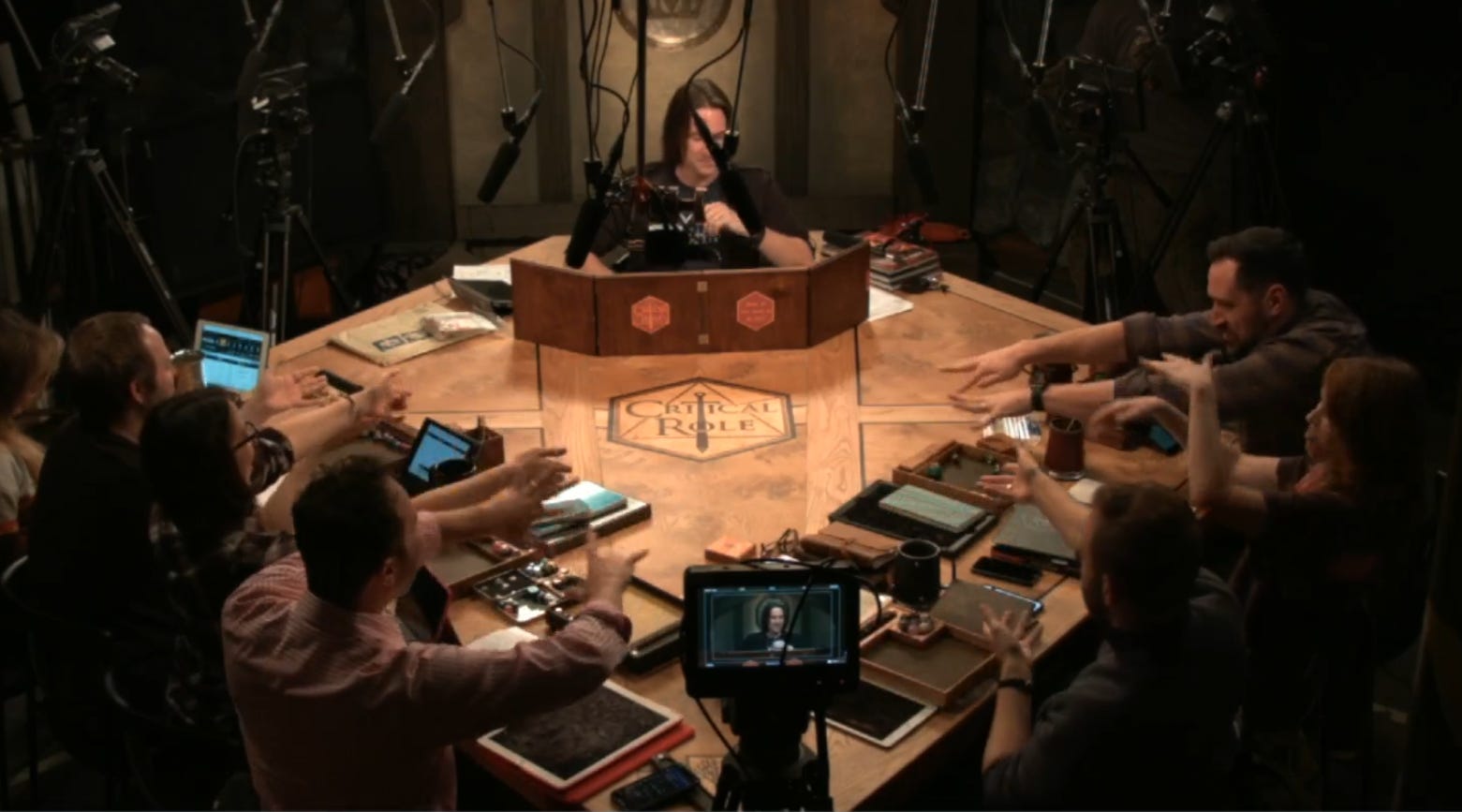
Critical Role is very popular for a good reason. Whether you are watching it as a fan of D&D, or because you enjoy the specific voice actors, or love the concept of fantasy drama, it is difficult not to appreciate what is good in the show.
Many will talk about the incredible 3D maps that the DM brings onto the table, or the light show and fog, the curated music playlists, but there is something I particularly love about Critical Role, and that is how well each member of the cast knows each other. In their sessions, you will often find that every player knows what to say and also when to say it. Per example, Scanlan (Sam Riegel) performs a lot of comic relief during the Vox Machina campaign, yet his character does not come across simply as comic relief. He has a strong storyline and character arc, that resolves without stripping away his penchant for comedy.
This is what makes the show engaging to watch, for me. Seeing these people improvise while having a good understanding of how dialogue works, and knowing what each other wants and needs in a given scene, puts into perspective the big contrast when someone inexperienced tries to emulate it and fails.
The Bad: Performance over gaming
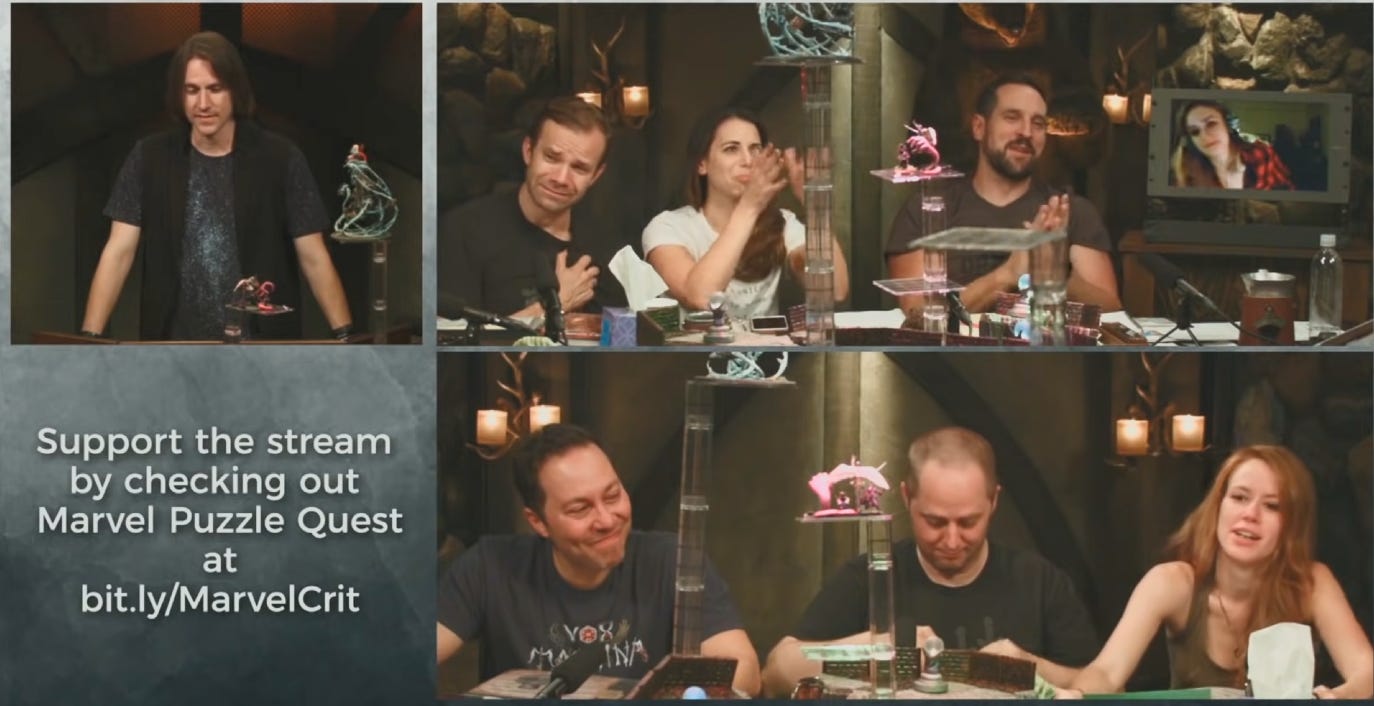
Over time, Critical Role has evolved to be more and more of a show and less and less of a game. The group went from being a close-knit group of friends to inviting other actors for variety and novelty, and the pacing of games dragged or rushed as the group strived to keep things interesting despite being off-script.
This caused the show to have some episodes that were intense and engaging, and others that felt like filler. The players’ interest in engaging with any and every NPC for deep conversation and roleplay meant that any moment in the game could turn into an hour long scene. At the same time, this also created a certain expectation in fans when it came to their own games: if a DM was not willing to turn every NPC into a fully named character with a page long backstory, ready to converse with the party, they felt it was lazy and shallow, and “Matt wouldn’t do it this way.” This falls back into the Mercer effect.
The performance over gaming also leads to people finding D&D to be something less than what it is. D&D is mostly a combat game, with some rules for exploration, survival and roleplay. There are other games that focus more on the roleplay aspect, and to prove this point, Critical Role eventually created Daggerheart, their own tabletop RPG where roleplaying takes the main priority.
Eventually, some people who played D&D started considering combat and exploration a minor aspect of the game, which lead to friction and frustration as parties clash when one member cannot fight effectively for the sake of “their character arc”, or one person insists on roleplaying when the rest wants to move on.
The Ugly: Parasocial Toxicity
As with any other celebrity, fans took to the Critical Role cast like moths to a flame. I’m not even going to talk about the cases where the cast itself was under fire (per example, Marisha Ray being so criticized during the first campaign), but rather, how the ideas of these players thinking they are just like the cast causes them to separate themselves from the actual table.
To put it bluntly: Critical Role’s party is a bunch of professional actors. The fan who is now going to try D&D is (in the great majority of cases) not a professional actor. There is this delusion that if Liam O’Brien can have ten minutes in a solo scene to monologue about his character’s perception of the party, then this other person who is not him can also have the table listen to them monologue for ten minutes, without the gravitas nor immersion that comes with years of acting under your belt.
When this spreads to a party-wide expectation, the results are catastrophic. You don’t want to point the finger at your friend and tell them “you’re bad at acting, so please tone it down”, but you also don’t want to sit there being judged because you don’t want to expose yourself in roleplaying scenes that last an hour, when you made your character to fight monsters and get rewards.
There is a fine balance here: you shouldn’t be too shy to roleplay! It’s a great experience when everyone immerses themselves in their character and forms real bonds as the characters rather than the players. But you should also understand that the ability to make others care about your character is not directly tied to how good of an actor (or actress) you are. You can play a year-long game without a single action spoken in first person, and have the table cry when you die.
You can also drag games to last twice their original length by forcing everyone to listen to you roleplay and narrate everything dramatically, and instead have them be relieved when your character dies.
Conclusion: You aren’t Critical Role.
This article may be a bit more angry-sounding than usual, but that’s because, after I found out the type of player that I am, I found myself between two worlds. I am too much a roleplayer to fit with the tables that don’t care for it, but I am not so intense or delusional to fit at the tables that think they are professional voice actors.
Everyone has their limits, things they shine at and things they don’t do so well. I am not good at accents and making voices, but I am great at using different vocabularies based on my character’s education, per example, and understanding what drives my character to do X or Y.
Still, if I reach a table where people want to roleplay, and someone insists on acting as if they were on a stage, or chatting for 10 minutes with every NPC we meet, I’ll be leaving that table. That’s just me, though.
Final Thought
If you enjoyed reading this (or the other articles), there’s a new thing I opened: a Ko-Fi.
I don’t want to activate paid subscriptions, but this is an extra way for me to receive positive feedback. Speaking of feedback, there is also this survey I made to gather feedback. It doesn’t register email addresses, or any data other than the answers to the questions, and it would help me greatly.
Finally, you can also…
… to receive every article straight to your inbox! And with that, I’m off for now.